
Why your shoulder isn't recovering at night
During the night your body is supposed to recover. Tissues repair, muscle fibers grow, injuries heal. All the stuff your training depends on happens while you're asleep.
But here's the problem if you sleep on your side: your shoulder is taking a beating the entire time.
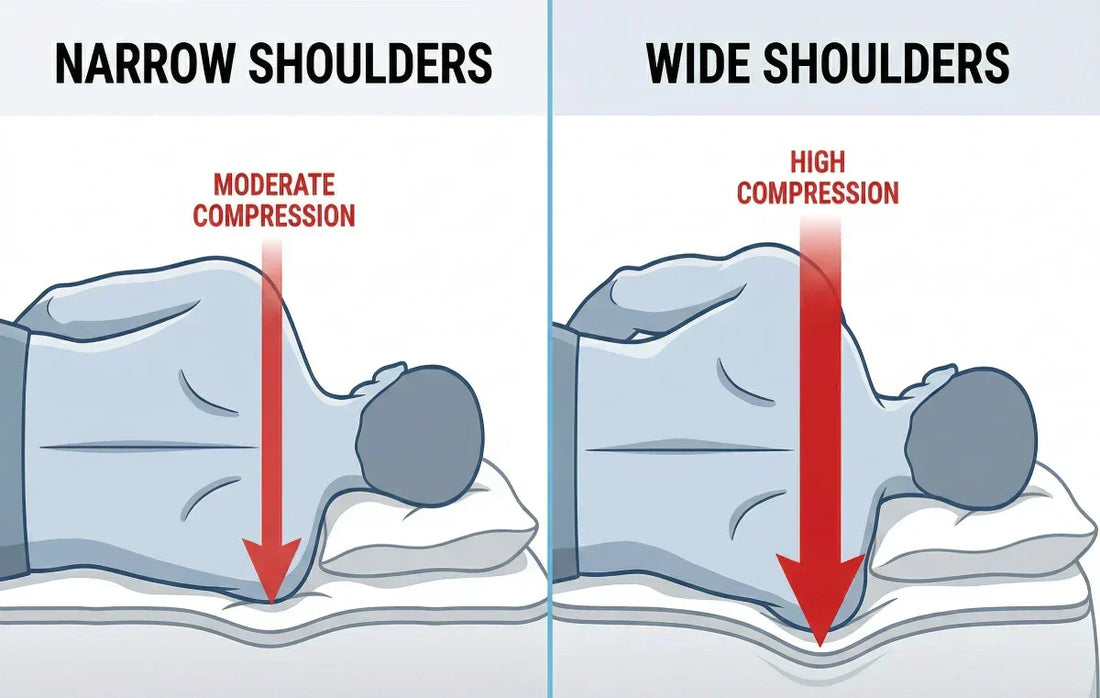
Think about it. Your shoulders are the widest part of your body. When you lie on your side, the first thing jammed into the mattress is your bottom shoulder. And it stays there, absorbing the full weight of your upper body for eight hours. That's not recovery. That's compression.
It isn't just a comfort issue. Somewhere around 80–85% of your upper body weight is pressing down onto a single joint all night long. Your shoulder has nowhere to go: it rolls forward and gets pinned against the mattress. Meanwhile your body is trying to recover around it.
Every side sleeper deals with this to some degree. But if you've spent years building your shoulders — adding mass, adding width — that's exactly what's working against you at night. Bigger shoulders stick out more. They get pinned harder. And the damage stacks up over time in a way that no amount of foam rolling or massage gun work is going to undo, because the compression continues every single night when you go to sleep.
Why your pillow was never going to fix this
You've probably tried different pillows. Maybe a lot of them. And none of them helped much, which makes sense once you realize what they were actually designed for.
The entire pillow industry is built around your head. Pillow height, firmness, neck curvature: all of it is optimized for the 10 to 12 pounds sitting on top of your spine. But nobody built anything to support your torso. Your shoulder was just expected to carry the weight.
For someone with average shoulders, that's an annoyance. Maybe some morning stiffness. For someone carrying real upper body mass? It's quietly wrecking your recovery every night.
The fix is almost stupidly simple
Once you understand it, you can't stop thinking about it: if the shoulder gets crushed because the torso presses down on it, then lift the torso.
That's it. support the torso from hip to ribcage, spread the load across the full length of your trunk, and suddenly the shoulder isn't bearing all the weight anymore. Instead of getting smashed into the mattress, it just rests there in a neutral position. Decompressed. Actually able to recover.
It's one of those solutions that feel obvious in hindsight. The pillow industry just never looked below the neck.
How the Papaya Pillow works

The Papaya Pillow is a torso pillow, not a head pillow. It sits underneath your body from your ribcage down to your hip and thighs, creating a gentle incline that's shaped to your frame. You use it alongside your regular head pillow and together they do something no standard pillow setup can do: they give your shoulder somewhere to go.
Your shoulder drops into that gap and stays in a neutral position all night. No compression. No forward roll. Just space.
Adapting to your natural sleep movement
Chances are you aren't sleeping on your side 100% of the time. That's why a modular approach works best.
If you shift positions during the night, you're not stuck. Roll onto your back? Push the Papaya Pillow aside. Return to your side? Pull it back under. Because it's separate from your head pillow, repositioning becomes second nature within a few nights.
Adapting to your body type
There's another benefit to the modular approach. You can choose the head pillow that matches your needs.
As a general rule: the less you sink into the Papaya Pillow's memory foam, the thicker your head pillow should be. The more you sink in, the less height you'll need. You're free to adjust and find what works for you.
If you don't have a pillow that's thick enough, you can stack up two flat ones. Here's another trick one of our customers came up with: Fold a large towel and put it under your head pillow for a simple DIY pillow booster.
Will it work for you?
The Papaya Pillow is a specialized solution, not a one-size-fits-all product. It's not for you if you mainly sleep on your back. But if you are a side sleeper most of the time and dealing with shoulder pain, the Papaya Pillow is built specifically to solve your problem.
There's no downside to trying it — you're covered by our No Pressure Guarantee. That gives you 30 nights to adjust to the new sleeping position and find out if your shoulder actually recovers the way it should.
⭐⭐⭐⭐⭐ "Took about a week to get used to the new sleeping position, but now my shoulder feels noticeably better in the mornings." — Brad
⭐⭐⭐⭐⭐ "It’s the only pillow or bed that has helped my shoulder pain! I highly recommend it to anyone with shoulder pain or numbness in arms." — Mike
Click on the button below to try the Papaya Pillow risk free!
